

API Documentation
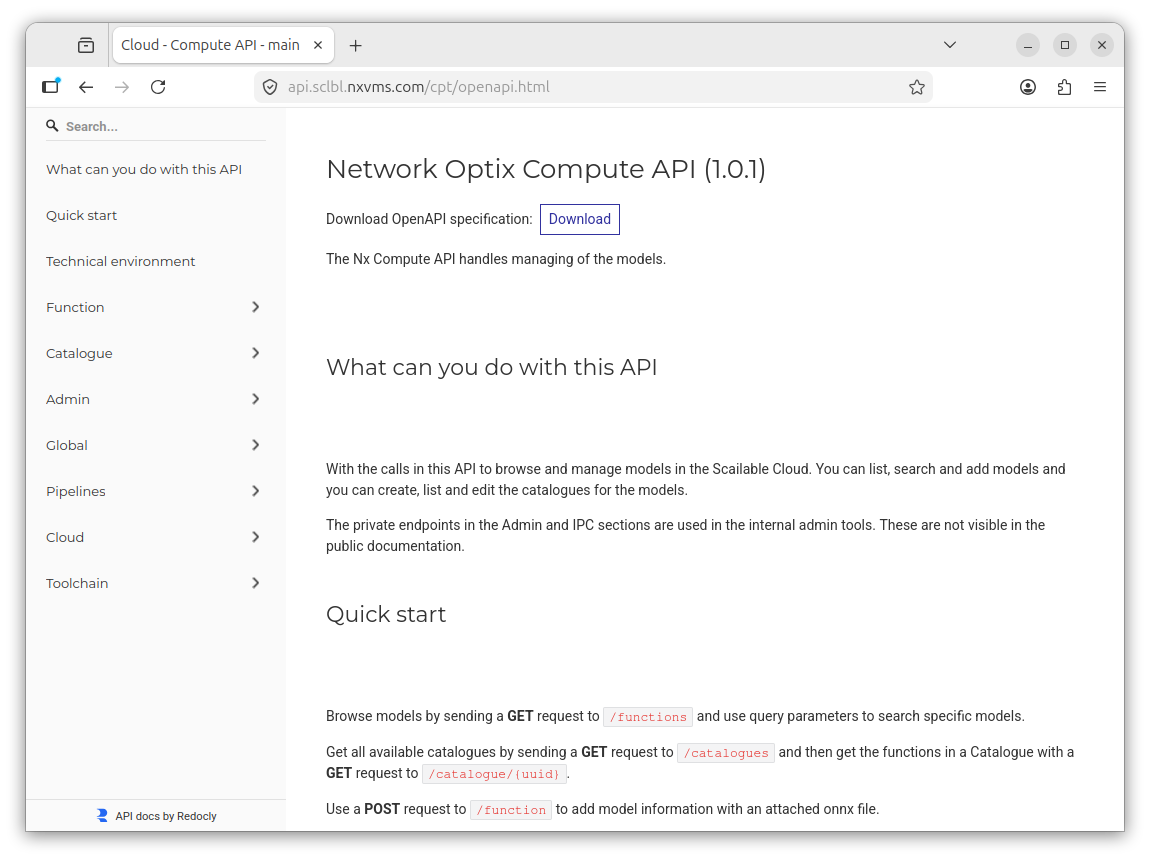
The AI Cloud exposes two REST APIs: one for managing AI models and catalogues, and one for managing edge devices and sites. Both are documented via OpenAPI (Swagger UI).
The raw OpenAPI JSON specifications are available at /cpt/openapi.json and /dev/openapi.json on the same host.
Authentication
All API endpoints require a Bearer token obtained via the Nx OAuth2 flow.
Getting a token
The token exchange happens automatically when you log in through the AI Cloud admin interface. For programmatic access, follow the OAuth2 authorization code flow against the Nx Cloud identity provider:
The response includes an access_token (JWT). Use it as the Bearer token in all subsequent API calls.
Note: The
codeparameter is obtained via the OAuth2 authorization code redirect flow, which requires a browser. For interactive testing, use the Swagger UI linked in the Authentication section above. Headless programmatic authentication is not yet covered here.
Using the token
Pass the token in the Authorization header on every request:
Multi-tenant context (acting as an organization)
Users with access to multiple organizations can make API calls on behalf of a specific organization by passing two additional headers:
X-Act-As-Kind
user, organization, channel_partner
The entity type to act as
X-Act-As-ID
UUID of the organization
The organization UUID
Omitting these headers causes the API to act as the authenticated user (personal context).
Pagination
List endpoints return paginated results. The total record count is exposed in a response header:
X-Pagination-Records
Total number of records matching the query (regardless of page size)
Pagination parameters vary by endpoint; see the OpenAPI spec for limit and offset query parameters.